
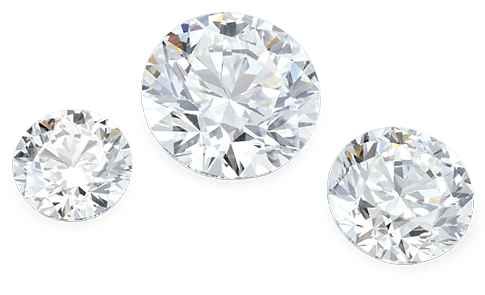
Fine diamonds are among the world’s most coveted gemstones. To determine a diamond’s value, experts use the Four Cs—cut, color, clarity, and carat weight.
1. Cut
A diamond’s overall proportions, as well as the size and position of its facets, make up the cut. The consistency and balance of these can greatly affect how the stone captures light and reflects it back to the eye.
Studies have been conducted to find the optimum proportions of a diamond’s cut so that it has the greatest amount of sparkle. If its cut falls within these parameters, it is considered an ideal cut.
Commonly used terms regarding refraction and light:
- Brilliance: The combination of all of the white light reflected from the surface and the inside of the diamond.
- Dispersion (Fire): Flashes of color you see in a polished diamond.
- Scintillation: Flashes of light you see when the diamond, the light, or the observer moves.
Proportion Categories:
- Too Shallow: Light escapes from the bottom of the gemstone.
- Ideal: Light enters the diamond and is returned beautifully through the top.
- Too Deep: Light escapes from the pavilion (sides of the lower half).
2. Color
With the exception of fancy-colored diamonds, the most valuable diamonds are those with the least color. Although many people think of gem-quality diamonds as colorless, completely colorless diamonds are very rare.
Each letter grade represents a range of color that is determined by a manual process of comparing the diamond to a master set.
| D-E-F | G-H-I-J | K-L-M | N-O-P-Q-R | S-T-U-V-W-X-Y-Z | Z+ |
|---|---|---|---|---|---|
| Colorless | Near Colorless | Faint Yellow | Very Light Yellow | Light Yellow | Fancy |
3. Clarity
A diamond’s clarity is measured by the existence or absence of visible flaws. Tiny surface blemishes or internal inclusions, even those seen only under magnification, can alter the brilliance of the diamond and thus affect its value.
- FL (Flawless): No internal or external clarity characteristics.
- IF (Internally Flawless): No internal clarity characteristics under 10x magnification.
- VVS1, VVS2 (Very, Very Slightly Included): Difficult to see under 10X magnification.
- VS1, VS2 (Very Slightly Included): Inclusions not typically visible to the unaided eye.
- SI1, SI2 (Slightly Included): Visible under 10X magnification and may be visible to the unaided eye.
- I1, I2, I3 (Included): Inclusions easily visible to the unaided eye.
4. Carat Weight
Carat refers to the diamond’s weight. One carat is equivalent to 100 points, so a 75-point diamond is equal to 0.75 carats. Because larger diamonds are rarer, they have greater value per carat. Therefore, the price of a diamond rises exponentially in regards to its size.
Carat to Millimeter Size Reference
| Carat Weight (CT) | 3⁄8 | 1⁄2 | 5⁄8 | 3⁄4 | 1.0 | 1.25 | 1.50 | 1.75 | 2.0 |
|---|---|---|---|---|---|---|---|---|---|
| Millimeter (MM) | 4.2 | 5.2 | 5.6 | 5.8 | 6.5 | 7.0 | 7.4 | 7.8 | 8.2 |